All my life, I’ve imagined other versions of myself. One version drinks coffee and types away on a keyboard, watching the world through the screen. Another version slips through shadowed safehouses in Prague, a forged passport clutched in hand, whispering secrets no one else can hear. I’ve always been drawn to that other life, the world of espionage, of coded messages, quiet courage, and hidden sacrifices. In that world, the CIA, MI6, and Mossad aren’t just organizations. They feel like stages where ordinary people step into extraordinary roles, and I’ve spent my life imagining what it would feel like to walk in their shoes.
My fascination with espionage didn’t appear suddenly. It grew quietly, like something I had always been meant to notice.

Childhood Dream Careers and the Stories We Tell Ourselves
Every child has big dreams, of course, but mine were… classified. When I first learned that intelligence agencies existed, I felt an inexplicable connection. It wasn’t about the glamour (though, let’s be honest, James Bond helps), but the idea of using ordinary skills to protect something greater: my country, my community, the world. The thought of an organization operating quietly, behind the scenes, to keep nations safe felt almost intoxicating.
One of my most cherished memories is sneaking into my dad’s office when I was around eleven or twelve years old. His office was the ultimate forbidden zone. Besides the papers, contracts, and blueprints, there were shelves of old SAS novels lining the walls, their pages yellowed and smudged with the musky scent of aged paper. I would tiptoe over, heart racing, flipping through stories of MI6 operatives and shadow missions. Those stories didn’t just teach me about loyalty and sacrifice. They quietly shaped my sense of right and wrong. After all, in the world of spies, morality is rarely black and white.
My spy fantasies were fueled even more by my dad’s love for James Bond. He was a Roger Moore and Sean Connery superfan. I would sneak into the living room during his late-night movie viewings. He seemed mesmerized by the quiet confidence of the tuxedo-wearing agents — their gadgets, their charm, and the mystery of men who seemed to know more than they said. Sometimes, as a child, I wondered if in another life my dad might have been a spy too. It would explain the calm way he watches the world, as if he is always noticing things the rest of us miss.

I’ll never admit how many times I convinced myself that my backpack, filled with books and writing journals, was actually a briefcase of classified secrets during long family road trips.
What is interesting, and perhaps a little poetic, is that one of my older cousins found his calling in the world of the FBI. His dreams seemed filled with the steady hum of evidence labs, fingerprint dust, and long nights piecing together human puzzles. I still remember us sitting at my grandmother’s kitchen table one summer afternoon, the air thick with the smell of percolating coffee and lemon furniture polish, while he explained how investigators followed trails most people never even noticed. Mine drifted through silent corridors, hidden dossiers, assets, and messages meant to disappear the moment they were read.
When we spoke about it, there was never competition, only recognition. He chased clarity; I chased mystery. He imagined justice delivered in courtrooms; I imagined it protected in shadows. Looking back, I think we recognized something familiar in each other, a shared pull toward service, toward protection, toward stories most people never see unfold.
As I grew older, my fascination matured along with me. While Bond remained iconic, I found myself drawn to the grittier, more human side of espionage, especially through stories like the “Bourne” series. Jason Bourne wasn’t polished or glamorous. He was hunted by the very system he served, constantly running, constantly questioning. That complexity stayed with me. It reminded me that espionage isn’t just about its secrets; it’s about identity, loyalty, and the fragile line between duty and survival.
Espionage isn’t glamorous. It’s profoundly lonely.
For most of my life, espionage lived in books, films, and imagination. That changed the summer I unexpectedly walked into a place where those stories suddenly felt real.
When Imagination Met Reality: Inside the Berlin Spy Museum
My fascination with the CIA, Mossad, and MI6 took on new life during a summer trip to Europe. I had planned visits to the Holocaust Memorial, the Berlin Wall, and Checkpoint Charlie, but nothing prepared me for my unexpected visit to the Berlin Spy Museum.
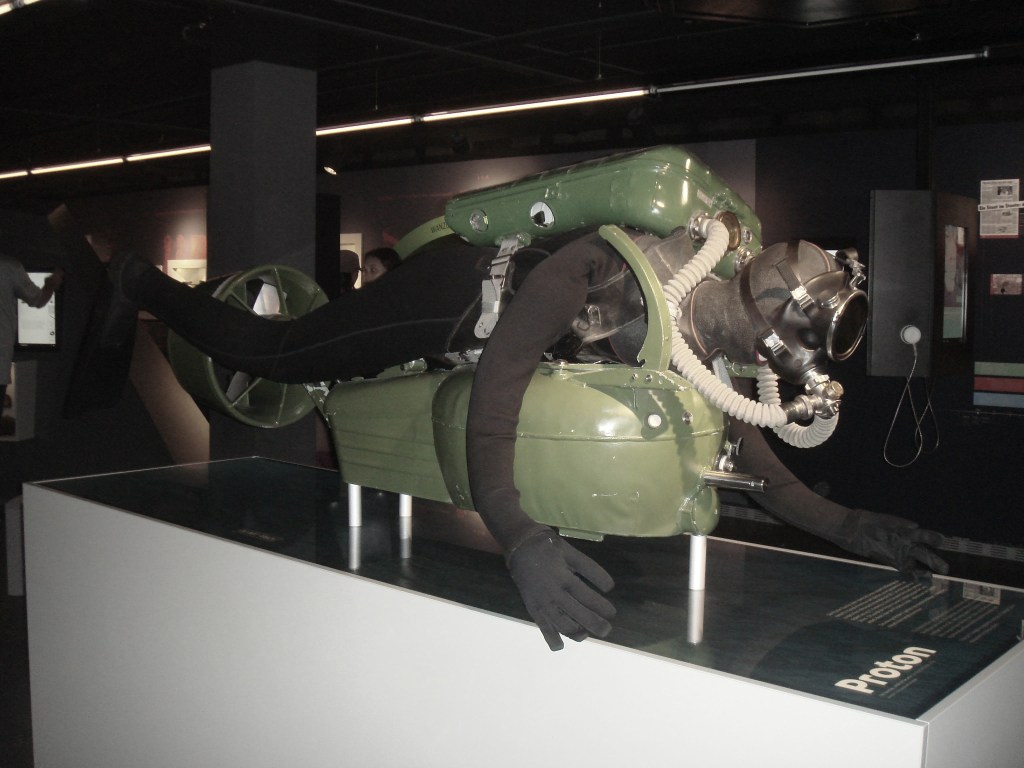
A Proton diving scooter used by the Special Forces of the Soviet Military Intelligence
Walking inside felt like slipping between two worlds. This wasn’t a museum filled with dusty displays and quiet plaques. It was alive. Interactive exhibits allowed visitors to handle replica spy gadgets, miniature cameras hidden inside pens, invisible ink, and listening devices disguised as cufflinks. One room seemed to recreate a Cold War interrogation, complete with a ticking clock and questions that made your pulse quicken, and another showcased artifacts that looked like they were from real operations, including KGB documents and CIA memos. The museum didn’t just tell the story of espionage. It allowed you to feel it. My visit felt less like tourism and more like stepping into a living archive of Cold War intelligence history.
Berlin itself felt like the perfect setting. A city shaped by division and Cold War tension, where spies were sometimes heroes and sometimes traitors, and where a single mistake could mean exile, torture, or worse. As I moved through the exhibits, I felt like I had stepped into the pages of a John le Carré novel, except this wasn’t fiction. These were real tools, real risks, and real human stories hidden behind history. Walking through those exhibits, I realized my fascination had never really been about the tools or tactics. It had always been about the people behind them.

Secrets, Service and Shadows: Why Espionage Has Always Felt Personal to Me
What has always drawn me to espionage isn’t just the gadgets (though they are fascinating), but the people behind them. The quiet courage of someone walking into a room carrying a passport that doesn’t belong to them. The emotional weight of a spy who may have to betray one cause to protect another. The humanity that exists beneath layers of secrecy and duty.
To me, agencies like the CIA, Mossad, and MI6 represent more than intelligence work. They represent a quiet promise, to protect in silence, to sacrifice for something larger than oneself, to remain in the shadows so others can live safely in the light. There is something deeply humbling about that.
Reality, of course, looks very different, and my life has followed its own path.
Living in the Shadows (Almost)
I’m not a spy in this life. I don’t wear a tailored suit to work (unless it’s a Zoom call emergency). I don’t have a “handler” texting me encrypted missions. But I still live with that same thrill. I devour spy thrillers, get lost in documentaries about Cold War double agents, and can’t resist a good historical mystery.

Because the truth is: I was meant to be a spy. Just not this one. The version of me in another universe? She’s training in a covert ops center, deciphering Morse code on a tablet, and sipping black coffee in a Berlin safehouse, waiting for the next mission.
And honestly? I wouldn’t miss this life for the world.
